Sweap set up for admins
Account setting
Administrator's guide to setting up your account
General account settings
Enable AI Feature
The event tags - creation and usage
Create guest fields for your account
Adding deletion rules to automatically delete guest data
Set up templates
User roles and permissions
Permission sets - Default user roles in Sweap
Permissions and configuration of default permission sets
User permissions and their functions in Sweap
Setting up new users
Use single sign-on
Roles and permissions
Visibility groups
Event-Ticketing - e-payment with Sweap
API and publishing package function
Implementing the event overview page within your website
Implementing the event overview page in an IHK24 website
Use Sweap's Zapier integration
Import of distributors with EVA
Import groups and committees from EVA master data
Sweap app and devices for check-in
Set up domain and email address
Getting started with Sweap - Basics
Event overview and dashboard
Basic structure of the event overview
The action field and its functions
The calendar view for your events
The event dashboard - overview
Event Sustainability Widget
Basic functions
Event formats in Sweap
What are event series?
Single event creation with Sweap
Create event series in Sweap
Create sessions for your event series
Using time zones in Sweap
Duplicate an event to use it as a template
The preview mode for creating emails or webpages
Using the correct image sizes
Create text with the HTML-Editor
AI feature in use in HTML editor
Use placeholders in Sweap
Customize headlines and text with HTML
Linking emails and websites in Sweap
Legal notice and privacy policy
Support and data protection at Sweap
GDPR-compliant consent management and cookie banners
Tracking-Tools on your Sweap event pages
Data tracking with Sweap
Privacy policy and GDPR
Questions about security & data protection
Sweap AI - Questions about security & data protection
Increasing security - introduction of Keycloak
Session limits - session limitation
Send your feedback about Sweap
The withdrawal button (Section 356a BGB) – implementing it with Sweap
Personal settings
Search and filter functions
The search function in Sweap
Using the filter function in Sweap
Last Update and Last Reply of your guests
Best practice, online webinars and updates
Create and manage contacts and guests
Create, import and export guest information
Add guests to your list
The guest import with Excel
Edit guest information and change status manually
Export your guestlist
Create and manage contacts
Add companions
Manage attributes for guests and divisions
Standard Fields and Event-Related Information in the Guest List
Create and edit attributes
Segmenting guests by categories
Postal mail invitation and QR code
Setting up and sending emails
Setting up and configuring emails
The email types and their use
Create mails more efficient with using the duplicating function
Testing emails in the editor: Here's how it works
Individual salutation
The guest salutation
Create guest salutation with our salutation assistent
Use your own salutation form in your emails
Dynamic email builder
Dynamic email builder: Create emails
Guest-Links and Token: Efficient Event Communication
Configure emails using a dynamic modular system
Design your email - Content
Design your email - Rows
Design your e-mail - General
Email wizard
The different types of email templates
The Email template LA LUNA
Static email wizard: creating emails
Configure emails - set up an invitation email
Call to Action Button withinin emails
Insert links for virtual events into emails
Insert stock photos into emails
Font types in emails
Troubleshooting for emails
Opt-In states and bounces
Reduce spam probability of emails
Display images correctly in my email
Delivery notification and bounces in the email log
Basics for the successful delivery of emails
Tracking email opening rates
Important information about blocked email addresses - status "mailjet: preblocked
Sending out emails
Registration pages & Virtual event platform pages
Registration page basics
Creating a registration page - basic steps
Metadata and SEO for registration pages
Deactivate event pages (URL link tracking)
Schema.org: Structured data for your event registration page
Registration page - using the Website Builder
Registration page - using the websitze wizard
Templates for your webpage
Contents and modules of a registration page
Texts, colours and design for the registration page
Settings to close the registration page - Website Wizard
Registration options settings within the Website Wizard
CSS & Java Scripts for website customisation
Header and footer within a website
Publish events on your own website
Font types on websites
Setting up the registration form
Configuration of a registration form
Add a checkbox with URL to the registration form
Show and hide form fields
Enter accompanying persons (registration form)
Newsletter Integration
Virtual Event Platform
Integrations and modules for the Virtual Event Platform
Operate and monitor events with Sweap
Label printing
Monitor events
Event status and the stages of your events
Postponing and cancellations of events
The confirmation status from guests
Event Insights - The key figures of your event
Sweap guestlist app and check-in
Sweap Budget
All on plans and licenses
Table of Contents
- All Categories
- Sweap Budget
- Create and Manage Event Budgets
- Organise Budget and Revenues
Organise Budget and Revenues

Organise Budget and Revenues
In this article, you’ll learn how to create and manage a budget for your event in Event Budget Manager.
1. Overview of your event budget
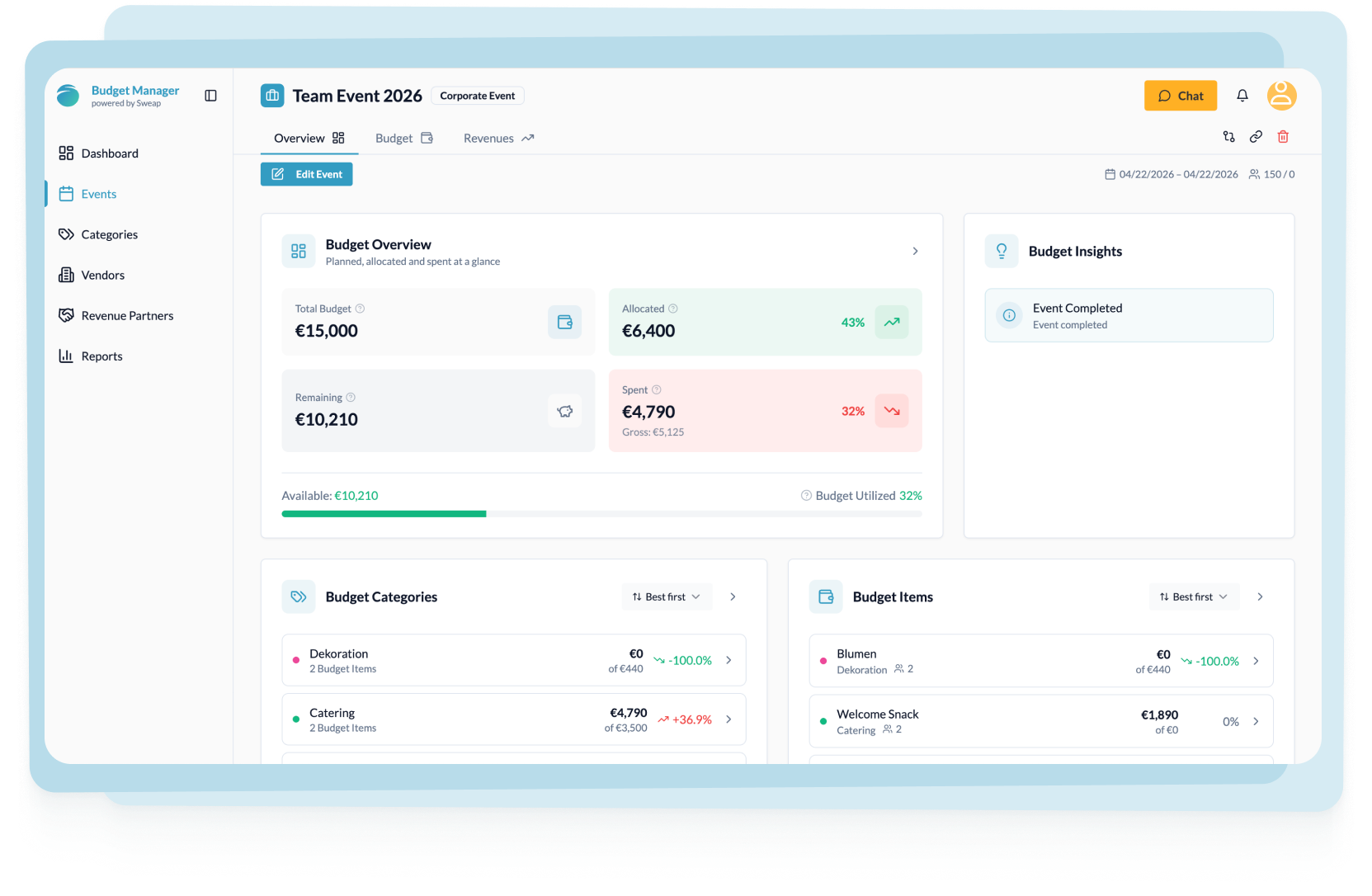
Once you’ve created an event, you’ll be taken to the event overview page. Here you’ll find all the relevant figures and insights:
- Budget: Total budget, Allocated, Remaining
- Expenditure: Amounts actually spent
- Budget Insights: Analysis of your budget planning
- Budget categories with quick access to the Budget tab
- Budget items with quick access to the Budget tab
- Vendors & Expenses with quick access to the Budget tab
- Event analytics: Cost per guest, tax overview
- Revenue tracking (if enabled): Expected and actual revenue
2. Creating and managing budgets
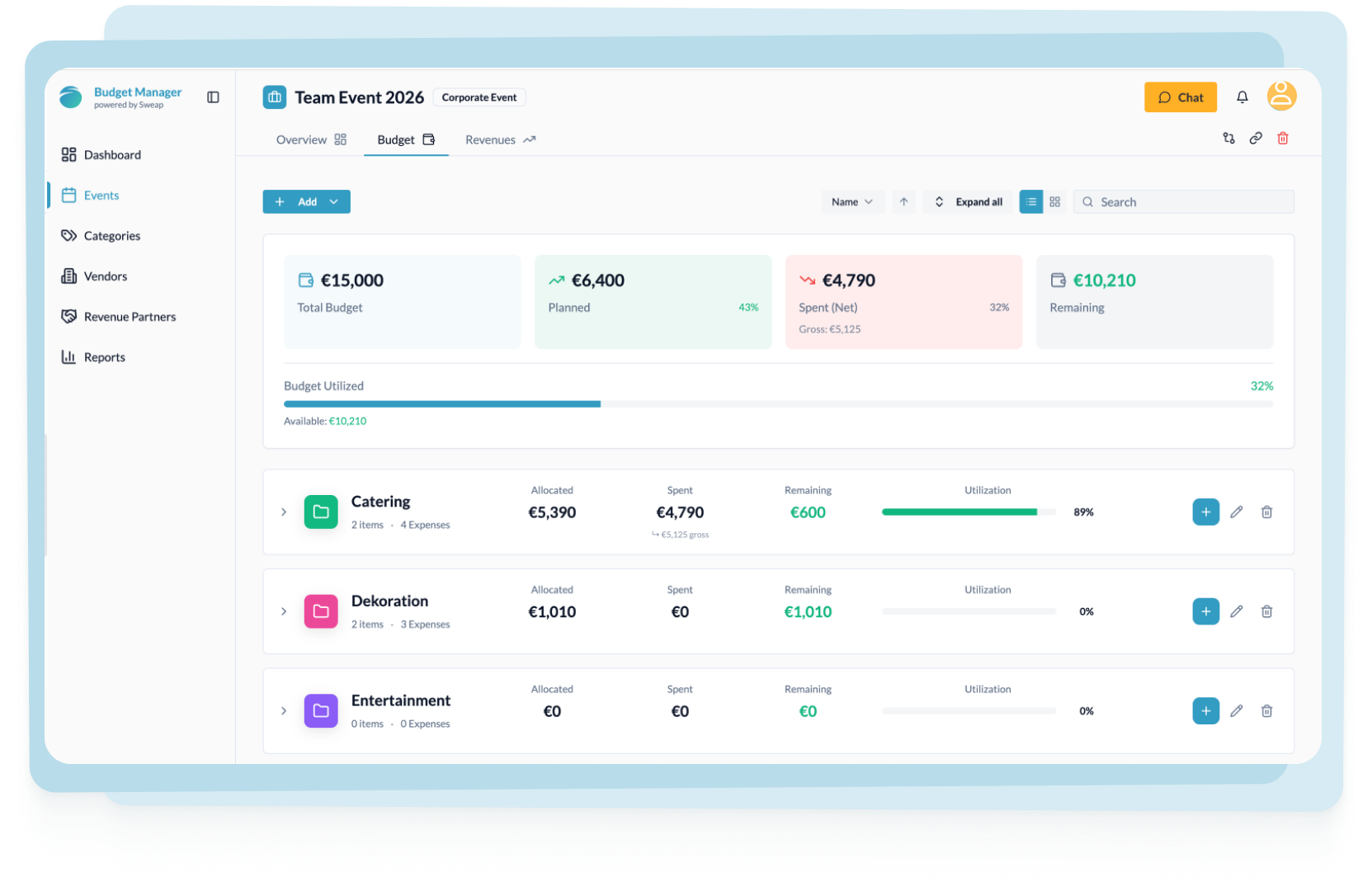
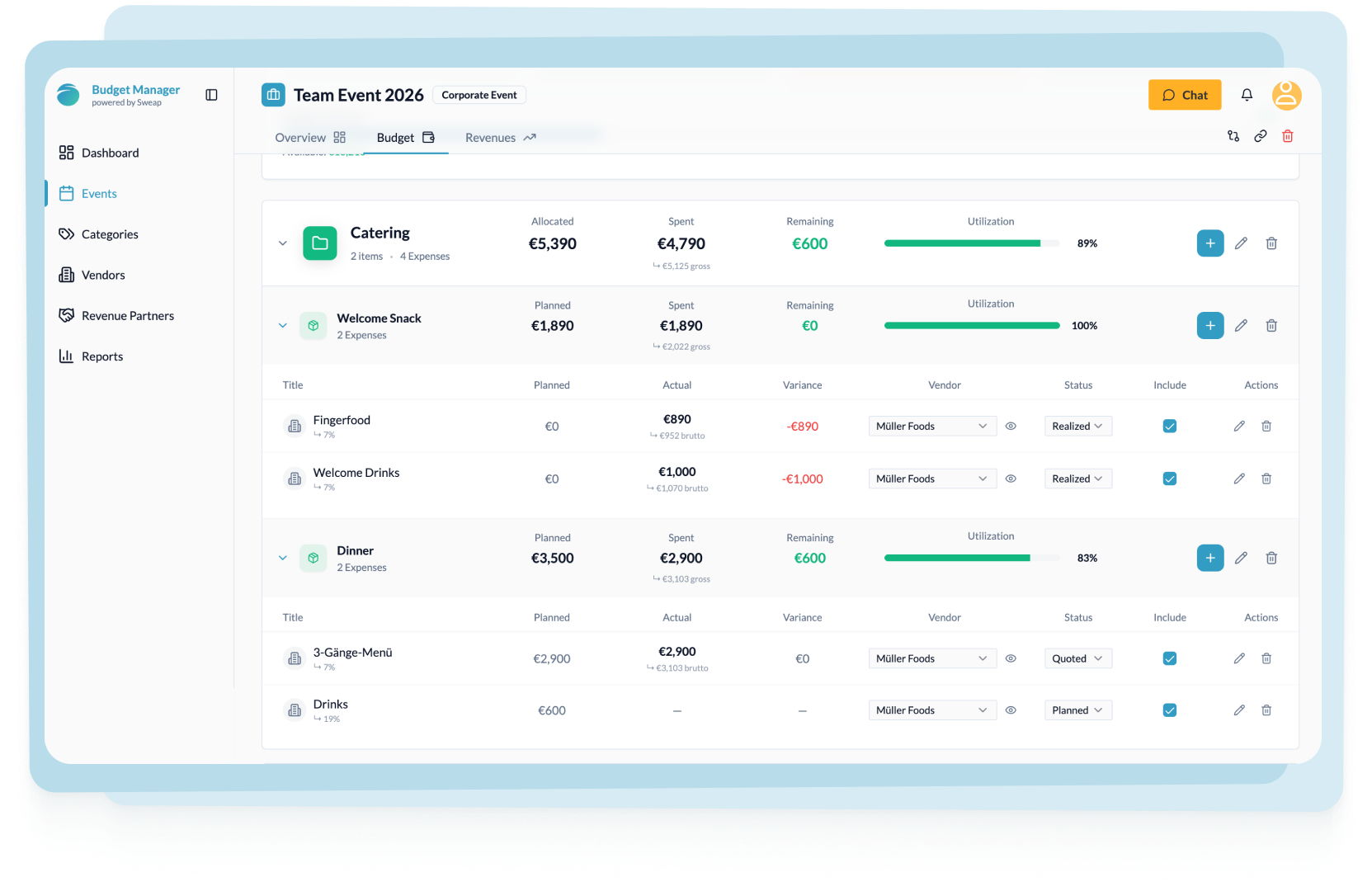
In the Budget tab of an event, you can manage all budget-related elements in one central location: categories, budget items and suppliers. The section is designed so that you can keep track of both the current status and the details of your budget planning at all times.
At the top, you’ll see a summary of the budget:
- Total budget – Your planned total budget
- Planned budget – Total of all allocated budget items
- Spent – Actual expenditure
- Remaining budget – What is still available
This overview is supplemented by a visual progress indicator (bar + percentage), which shows you how much of your budget has already been used.
2.1 Add categories, budget items, expenses & vendors
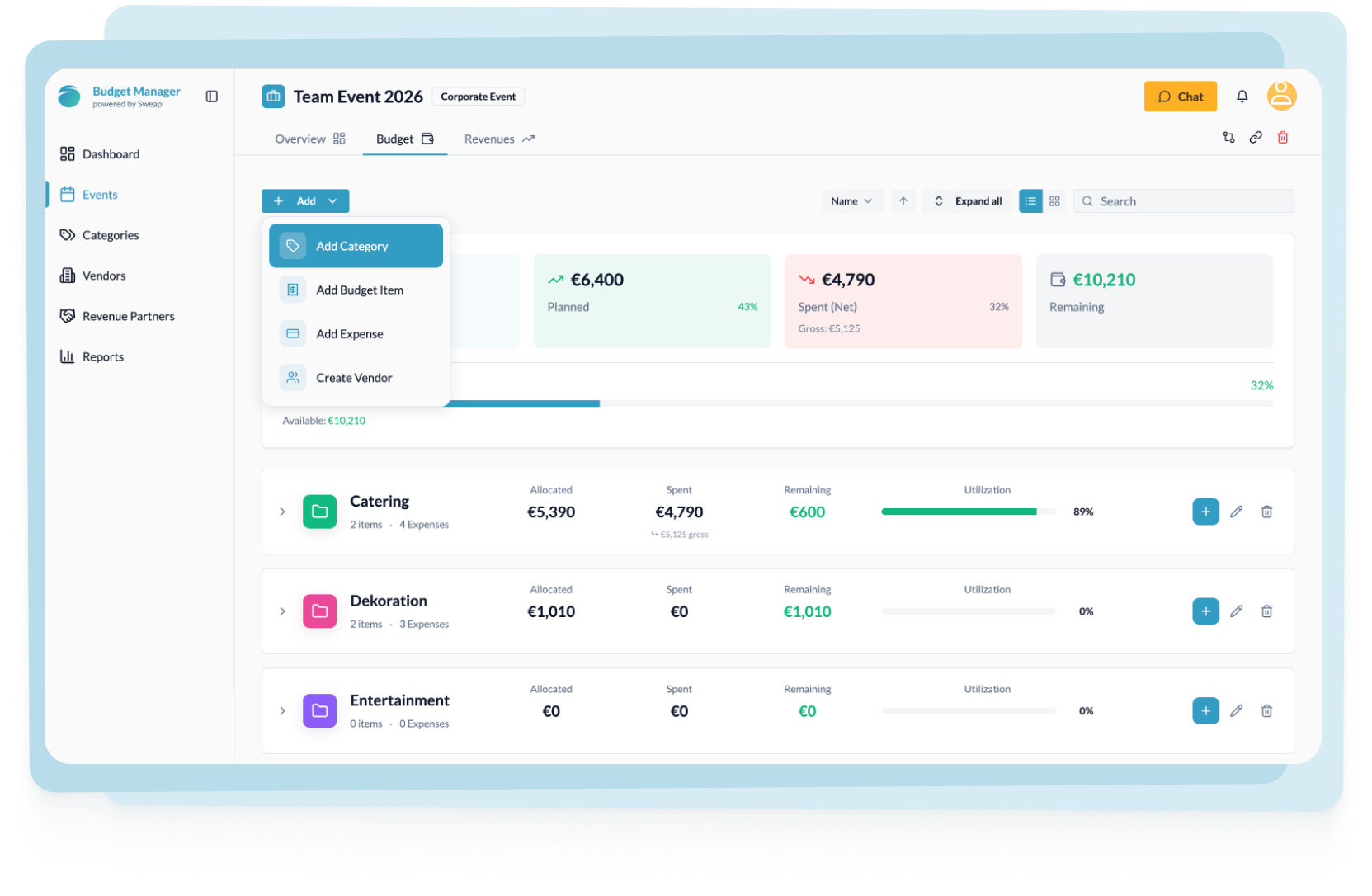
You can create new items at any time using the ‘Add’ button. In the drop-down menu, you can choose between:
- Category – Parent budget category (e.g. Catering)
- Budget item – Individual items within a category (e.g. menu costs)
- Expenditure – Specific costs allocated to a budget item
- Vendor – External suppliers with planned or actual expenditure
2.2 Structure overview
To help you keep track of your event budget at all times, the Event Budget Manager follows a clear hierarchy:
Category (e.g Venue)
- Budget item (e.g Venue hire)
- Expense (e.g. 2,500 €) including vendors with planned or actual expenditure
- Budget item (e.g Venue hire)
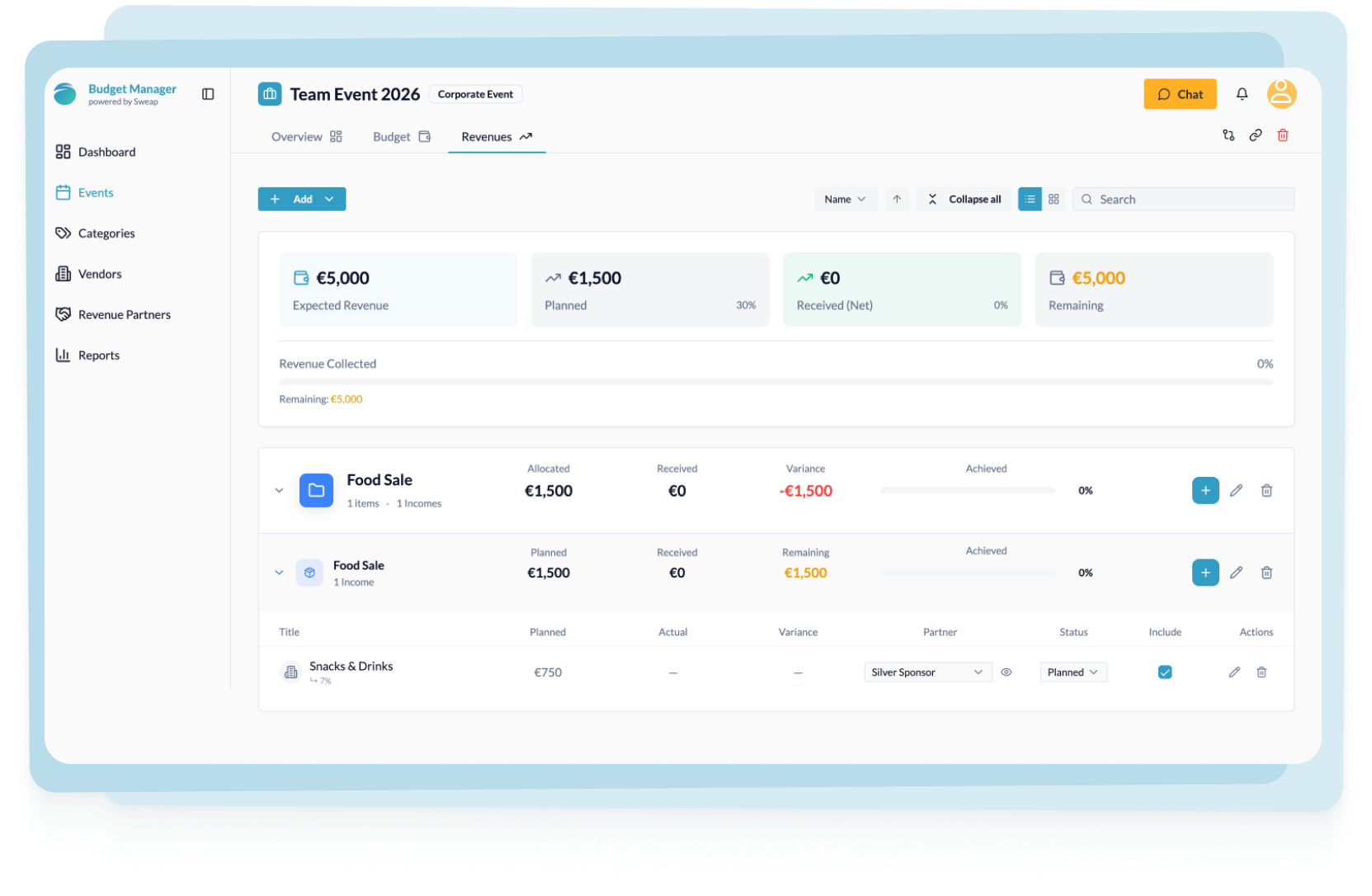
3. Add and manage revenue
If you enabled revenue tracking when creating the event, the Revenue tab will be available to you. This is where you can manage all revenue-related items in one central location.
At the top, you’ll see a summary of your budget:
- Expected revenue – Your planned revenue budget
- Planned revenue – Total planned revenue
- Revenue received – Actual revenue
- Remaining revenue – Outstanding revenue
This overview is supplemented by a visual progress indicator (bar + percentage), which shows you how much of your revenue has already been received.
Using the ‘+Add’ button in the Revenue tab, you can create revenue categories, revenue items, revenue entries and partners. The structure of revenue follows the same hierarchy as expenses: Revenue category – Revenue item – Revenue entry (including partner).